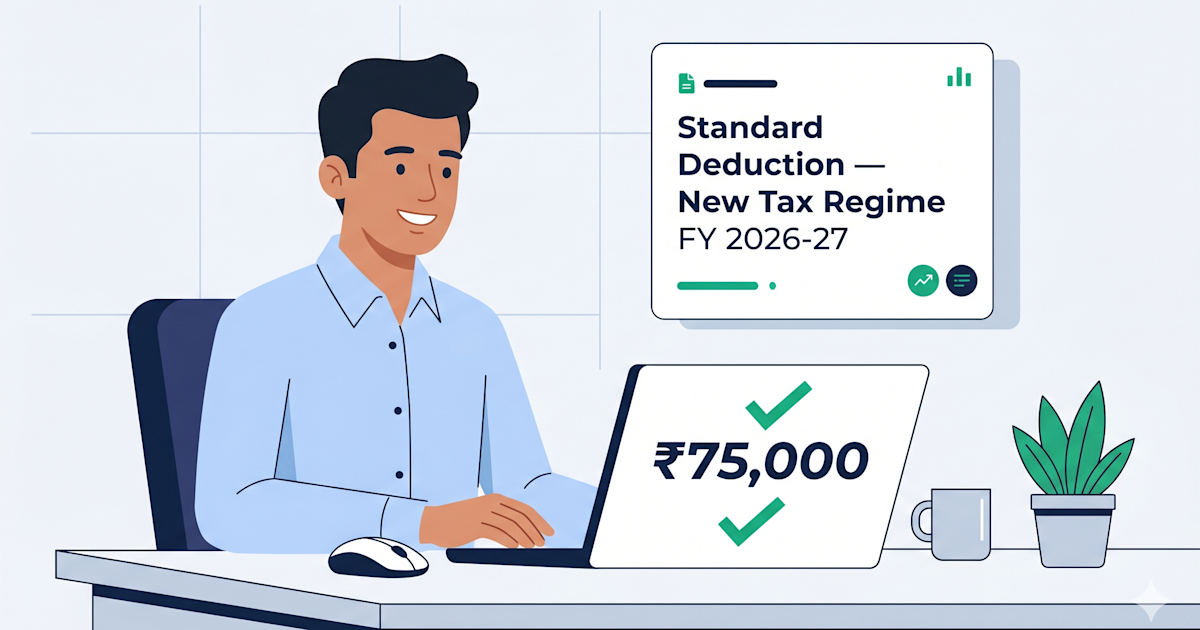
If you are a salaried employee in India, the government automatically reduces your taxable income by ₹75,000 every year under the New Tax Regime for FY 2026-27. You do not need to invest anything, submit any proof, or claim it separately. It applies to every salaried person by default.
This is called the Standard Deduction.
What Is the Standard Deduction?
The standard deduction is a flat amount that gets subtracted from your gross salary before your income tax is calculated. Think of it as the government acknowledging that salaried employees have work-related expenses — commute, professional development, work equipment, without asking you to prove any of it.
For FY 2026-27 under the New Tax Regime, the standard deduction is ₹75,000.
Under the Old Tax Regime, the standard deduction is ₹50,000.
How Much Tax Does It Actually Save?
The tax saving depends on which slab your income falls in. The standard deduction reduces your taxable income first, and then the slab rates apply on what remains.
If your taxable income after the standard deduction falls at or below ₹12,00,000, the Section 87A rebate eliminates your tax entirely under the New Regime for FY 2026-27.
Here is the tax saving at different income levels under the New Regime:
Annual Gross Salary ₹8,00,000 Taxable income before deduction: ₹8,00,000 After ₹75,000 standard deduction: ₹7,25,000 Tax saved: ₹7,500 (₹75,000 × 10% slab rate)
Annual Gross Salary ₹12,00,000 Taxable income before deduction: ₹12,00,000 After ₹75,000 standard deduction: ₹11,25,000 Tax: ₹0 (87A rebate applies — taxable income is below ₹12L) Without the deduction, taxable income would be ₹12,00,000 and tax would be ₹20,800 after cess. Tax saved: ₹20,800
Annual Gross Salary ₹15,00,000 Taxable income before deduction: ₹15,00,000 After ₹75,000 standard deduction: ₹14,25,000 Tax saved: ₹15,600 (₹75,000 × 20% slab rate + 4% cess)
Annual Gross Salary ₹20,00,000 Taxable income before deduction: ₹20,00,000 After ₹75,000 standard deduction: ₹19,25,000 Tax saved: ₹23,400 (₹75,000 × 30% slab rate + 4% cess)
The higher your income, the more tax the standard deduction saves in absolute rupee terms.
The ₹12.75 Lakh Zero-Tax Threshold - How It Works
This is the most important practical implication of the standard deduction for most salaried employees.
Under the New Tax Regime FY 2026-27, the Section 87A rebate applies if your taxable income is ₹12,00,000 or below. The rebate covers up to ₹60,000 of tax, which at taxable income of exactly ₹12L equals ₹20,000 net tax (the rebate brings it down from ₹80,000 to ₹20,000 — not zero). Tax reaches zero only when computed tax is ₹60,000 or less, which happens at taxable income of approximately ₹10.2L.
However, because of the standard deduction, a salaried employee with gross salary of ₹12,75,000 has taxable income of ₹12,00,000 after the ₹75,000 deduction. At ₹12L taxable income, the tax is ₹20,800 (after cess). This is not zero but is significantly lower than without the deduction.
The commonly cited "zero tax up to ₹12.75L" claim is a simplification. The actual picture: at ₹12.75L gross salary, you pay ₹20,800 in tax. The deduction saves you money but does not create a zero-tax situation at that income level.
New Regime vs Old Regime - Standard Deduction Comparison
New Regime FY 2026-27 | Old Regime | |
Standard Deduction | ₹75,000 | ₹50,000 |
Additional deductions allowed | No | Yes (80C, HRA, 80D, NPS, etc.) |
Best for | Income below ₹15.75L with no major investments | Those with 80C + HRA + other deductions above ₹1.75L |
The Old Regime gives you ₹50,000 standard deduction plus the ability to claim 80C (up to ₹1.5L), HRA exemption, 80D health insurance, NPS contribution (up to ₹50,000), and home loan interest (up to ₹2L). If the sum of all your deductions under Old Regime exceeds ₹1,75,000 (the difference between what you'd save in each regime), Old Regime is worth considering.
For most salaried employees without a home loan or large 80C investments, the New Regime is now more beneficial.
Who Gets the Standard Deduction?
Every salaried employee in India gets the standard deduction automatically. There is no form to fill, no investment to make, and no proof to submit. Your employer applies it when calculating your TDS every month.
The deduction applies to:
All salaried employees in the private sector
Government employees
Pensioners (pension income is treated as salary for this purpose)
Freelancers, consultants, and those with business income do not get the standard deduction. They are taxed under different provisions.
How It Appears on Your Salary Slip and Form 16
Your salary slip does not show the standard deduction, it is not a line item on a payslip. It is applied at the time of tax computation, not at the payroll level.
On your Form 16 (which your employer provides after the financial year), you will see it listed under Part B as "Standard Deduction u/s 16(ia)" with the amount ₹75,000. This is the document that confirms the deduction was applied when computing your TDS.
If you are filing your ITR yourself, select the New Tax Regime and the standard deduction of ₹75,000 will be pre-populated automatically under the salary schedule.
What Changed Between FY 2025-26 and FY 2026-27?
The standard deduction under the New Tax Regime was increased from ₹50,000 to ₹75,000 starting FY 2025-26 (announced in Budget 2024). For FY 2026-27, it remains at ₹75,000. No further increase was announced in Budget 2025.
Under the Old Regime, the standard deduction has been ₹50,000 since FY 2019-20 and has not changed.
See Your Exact Take-Home After Standard Deduction
The standard deduction is one of several factors that determine your monthly in-hand salary. Your PF contribution, HRA structure, professional tax, and income tax slab all play a role.
Use the CTC to In-Hand Calculator to see your complete salary breakdown, including exactly how the standard deduction affects your monthly take-home, based on your actual CTC.