Cognizant Bonus 2026: The Short Answer
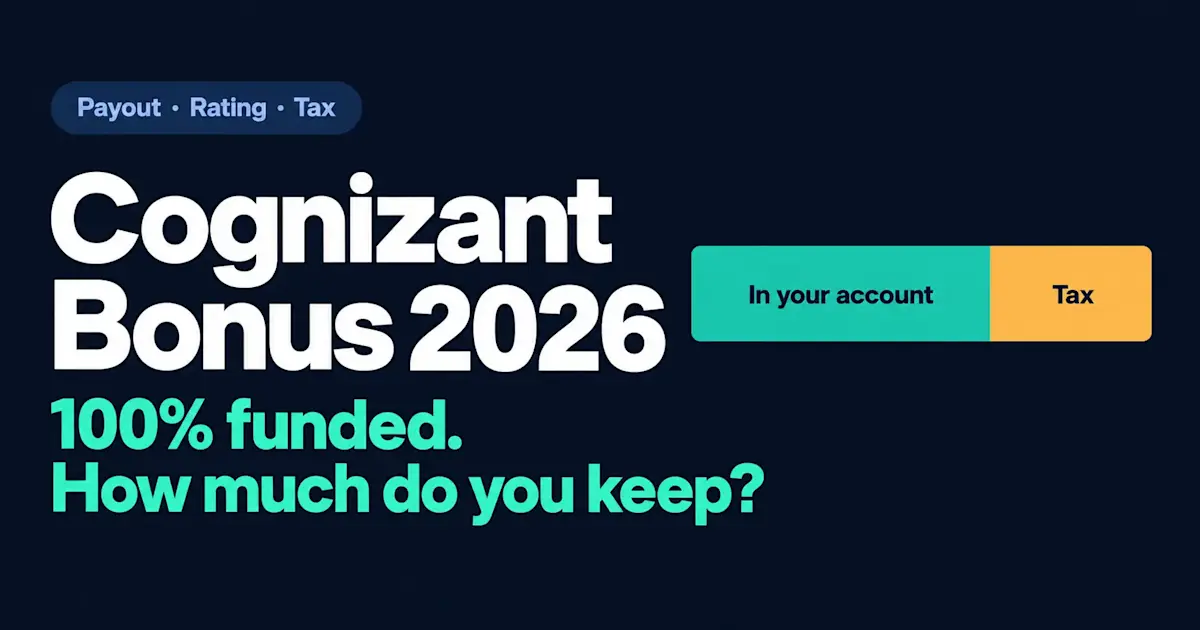
Cognizant funded its discretionary bonus pool at 100% for 2025 performance. CEO Ravi Kumar S announced it to employees in early February 2026, and it was the highest bonus funding in seven years.
The reason was a benchmark Cognizant calls the Winner's Circle. The company wanted to rank among the top four performers on revenue growth within its global peer group by 2027. It got there in 2025 instead, with 6.4% constant currency revenue growth, the highest among large IT services firms that year.
For employees, that meant a full bonus pool for once. Whether your own payout matched 100% depends on your rating, which we get to below.
When Is the Cognizant Bonus Paid?
Cognizant pays its annual bonus once a year, for the previous calendar year's performance. The timeline usually looks like this:
Stage | Typical timing |
GoPerform ratings released | January |
Bonus funding announced | Early February |
Bonus e-letters issued | February to March |
Amount credited with salary | March to April |
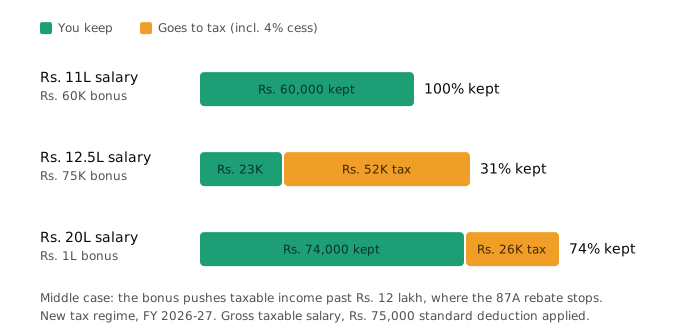
Cognizant doesn't publish an official payout date, and the credit month has shifted slightly between years. If you haven't seen it by the end of April, raise it with your HR business partner. Don't wait for an all-hands announcement.
The bonus is processed separately from your salary increment. A good bonus year says nothing about when your hike lands, and 2025 proved it. Bonuses went out in March, but merit hikes only took effect in November.
Is There a Cognizant Mid-Year Bonus?
Not for most associates. Cognizant runs one annual bonus cycle. The "mid-year bonus" people search for usually refers to one of three things:
Project or client-specific incentives, paid at the account's discretion
Retention bonuses given to specific people in high-attrition skill areas
Quarterly incentives in sales and some delivery leadership roles
If none of these apply to you, the annual payout is the only bonus you'll receive.
How Your Rating Affects Your Bonus
"100% funding" means the total bonus pool was funded in full. It doesn't mean everyone got 100% of their target. Cognizant hasn't disclosed the exact formula for individual payouts, but the pattern from previous cycles is clear. The pool is split by GoPerform rating, so top ratings get more than 100% of target and lower ratings get less.
In the 2024 cycle, when the pool was also strong, individual payouts ranged from 85% to 115% of target. A fully funded 2025 pool would likely follow a similar spread.
My read: if you were rated 3, expect close to your target. If you were rated 4 or 5, expect above it. At 1 or 2, expect a reduced payout or none.
How Much Tax Do You Pay on the Cognizant Bonus?
This is where most people get surprised. A bonus is taxed as salary in the month it's paid, so TDS on that month's payslip spikes. Your annual tax depends on where the bonus puts your total income for the year.
Under the new tax regime for FY 2026-27, the Rs. 75,000 standard deduction and the Section 87A rebate mean zero tax if taxable income stays at or under Rs. 12 lakh. That creates a cliff right at Rs. 12 lakh.
Example 1: bonus stays under the line. Gross taxable salary is Rs. 11 lakh, bonus is Rs. 60,000. Total is Rs. 11.6 lakh, and taxable income after standard deduction is Rs. 10.85 lakh. Tax is zero, so you keep the full Rs. 60,000.
Example 2: bonus pushes you over the line. Gross taxable salary is Rs. 12.5 lakh, bonus is Rs. 75,000. Without the bonus, taxable income is Rs. 11.75 lakh and tax is zero. With it, taxable income is Rs. 12.5 lakh. Slab tax would be Rs. 67,500, but marginal relief caps it at the income above Rs. 12 lakh, which is Rs. 50,000. Add 4% cess and you pay Rs. 52,000. You keep only Rs. 23,000 of a Rs. 75,000 bonus.
Example 3: higher salary. Gross taxable salary is Rs. 20 lakh, bonus is Rs. 1 lakh. The bonus falls in the 25% slab, so tax plus cess on it comes to Rs. 26,000. You keep Rs. 74,000.
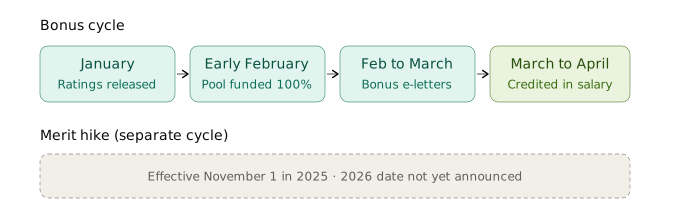
Example 2 is the one to watch. If your salary sits just under Rs. 12.75 lakh, a bonus can cost you most of its own value in tax. Employer NPS under Section 80CCD(2) is one of the few deductions allowed in the new regime. If your Cognizant CTC offers it, ask HR whether you can restructure to use it.
Run your own numbers on the income tax calculator. It compares both regimes on your exact salary.
Cognizant Promotion Cycle 2026
Promotions at Cognizant run alongside the annual appraisal. Ratings drive both, and promotion letters usually follow the merit cycle. Cognizant hasn't announced a date for the 2026 promotion cycle.
The 2025 cycle gives a reference point. Merit hikes took effect on November 1, 2025, for about 80% of eligible employees, and covered everyone up to senior associate level. Manager level and above were largely left out of that round. Expect the same split in the next cycle: associates first, managers later or not at all.
For the hike side of the story, including in-hand impact at each salary level, see our Cognizant hike 2026 breakdown.
What About the Bonus for 2026 Performance?
The next bonus, for calendar year 2026, would be announced around February 2027. Whether it's fully funded again depends on whether Cognizant holds its Winner's Circle position. The company has revised its 2026 revenue growth guidance to 4.0% to 5.5%, down from 6.4% in 2025. That makes a repeat 100% pool less certain.
My honest view: treat 2025 as a strong year, not the new normal. Don't plan big expenses around a bonus that hasn't been announced.
Should the Bonus Change Your Stay-or-Switch Decision?
A one-time bonus doesn't move your base salary, and your base drives every future hike, your PF, and your next offer negotiation. If you're 2 to 4 years in and your base has barely moved, a good bonus year doesn't fix that.
Use the salary hike calculator to see what your next increment adds per month. Then compare that with an external offer on the in-hand to CTC calculator. For entry-level pay benchmarks, see the Cognizant fresher salary page.