What HAL Actually Pays a Management Trainee
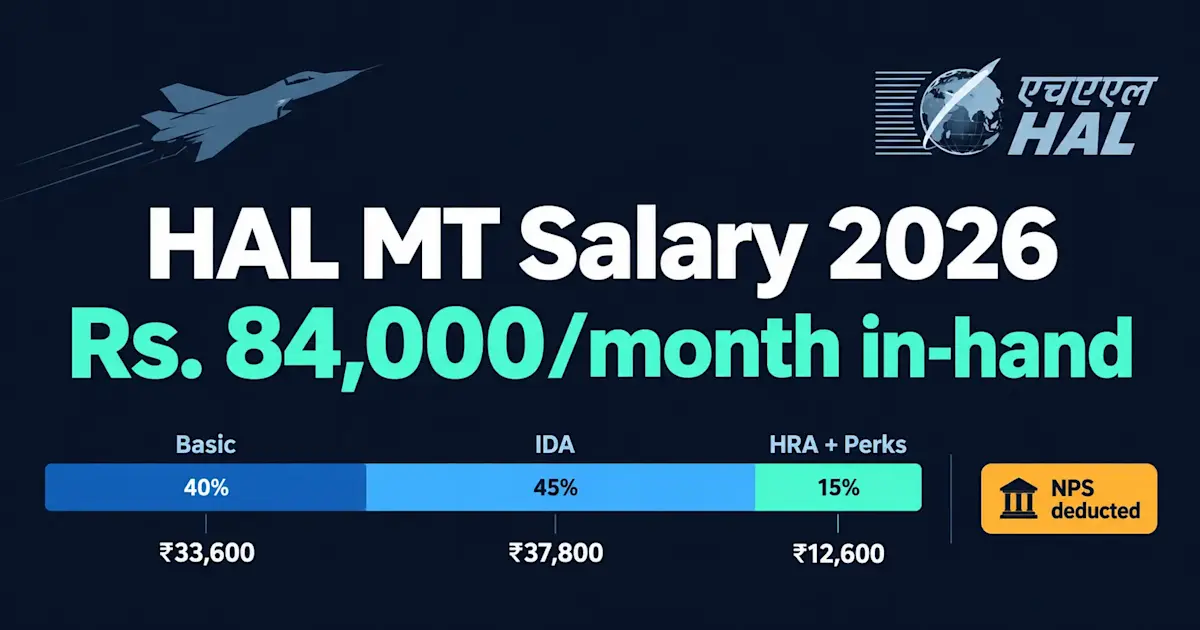
If you've joined HAL as a Management Trainee or are preparing for the written test, the number you keep seeing -- Rs. 40,000/month -- needs a lot of unpacking. That figure is your basic pay. Your CTC is higher. Your take-home is lower. The difference comes down to three deductions that most salary guides skip: NPS, PF, and income tax.
This post walks through the full structure, tells you exactly what lands in your account each month, and explains what changes as you move up bands.
HAL Pay Scale for Management Trainee (MT Grade)
HAL follows the IDA (Industrial Dearness Allowance) pay scale pattern used by most Schedule A PSUs. Management Trainees are placed in the E1 grade on joining.
Component | Amount (per month) |
Basic Pay | Rs. 40,000 |
IDA (currently ~54%) | Rs. 21,600 |
HRA (30% of basic, metro / 20% non-metro) | Rs. 12,000 / Rs. 8,000 |
Perks and Allowances (~35% of basic) | Rs. 14,000 |
Gross CTC (approx.) | Rs. 87,600 -- Rs. 91,600 |
IDA revisions happen quarterly. The figure above uses the current DA rate and will shift slightly with each revision. Perks are paid as a consolidated allowance -- you can split them between transport, food, and other heads, which matters for old-regime tax planning.
The NPS Deduction -- What No One Tells You
This is where HAL salary math gets confusing. Unlike private sector companies that contribute to EPF, HAL (like all central PSUs) runs the National Pension System for its employees.
NPS works like this:
Employee contributes 10% of basic pay every month
HAL contributes another 14% of basic pay on your behalf
Both amounts go into your NPS Tier I account and are locked until age 60
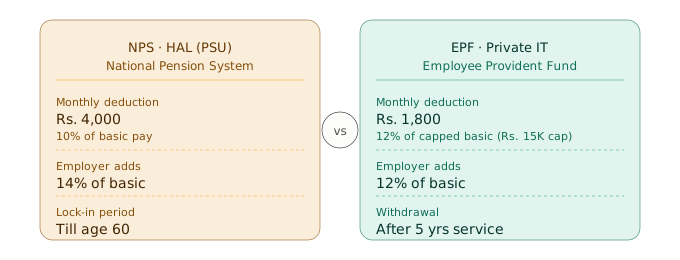
So from your take-home perspective, Rs. 4,000 per month (10% of Rs. 40,000 basic) disappears into NPS before you see any money. HAL's 14% contribution (Rs. 5,600) is over and above your gross -- it does not come out of your pocket but also does not hit your bank account.
There is no EPF here. If you are comparing HAL with an IT company that deducts EPF, note that EPF (12% of capped basic, roughly Rs. 1,800/month for most people) is a smaller deduction than NPS. HAL's NPS bite is steeper month to month, but you are building a retirement corpus with employer co-contribution that most private sector employees do not get.
Exact In-Hand Calculation for HAL MT (2026)
Let's run the numbers for a Bangalore-posted MT on the new tax regime.
Gross Monthly (approximate): Rs. 91,600
Deductions:
Deduction | Amount |
NPS (employee, 10% of basic) | Rs. 4,000 |
Income Tax (new regime, annualised) | ~Rs. 3,200 |
Professional Tax (Karnataka) | Rs. 200 |
Total deductions | ~Rs. 7,400 |
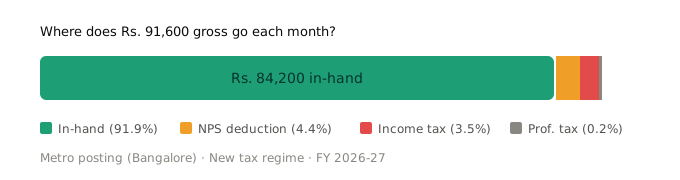
Monthly In-Hand: approximately Rs. 84,000 -- Rs. 85,000
A few things to note. Annual CTC at this level lands around Rs. 9.5 -- 10 LPA when you include HAL's NPS contribution and other benefits. Under the new tax regime, the standard deduction of Rs. 75,000 and the 87A rebate (zero tax up to Rs. 12L taxable income) work in your favour here -- most MTs end up paying very little tax in their first year.
If you are in non-metro (Lucknow, Nashik, Korwa -- all major HAL plants), HRA drops from Rs. 12,000 to Rs. 8,000 and your in-hand comes down by roughly Rs. 3,000 -- Rs. 4,000, landing around Rs. 80,000.
Want to run this for your exact CTC? Use the CTC to in-hand calculator -- plug in Rs. 10 LPA and toggle PF off to model the NPS scenario.
HAL Salary Slip Breakdown
Your salary slip at HAL will show two distinct sections: earnings and deductions. Here is what each line item means.
Earnings side:
Basic Pay
IDA
HRA
Perks and Allowances (consolidated)
Medical Allowance (if applicable)
Deductions side:
NPS employee contribution (10% of basic)
Income Tax (TDS, if applicable)
Professional Tax
Recovery of advances (if any)
One thing people miss: HAL sometimes shows the employer NPS contribution as a notional credit on the CIP (Cost to Company in Position) statement they give at joining -- this is not your take-home, it is the cost HAL bears on your behalf. Do not mistake the CIP figure for your gross salary.
Want to see what a HAL-style salary slip looks like with all components filled in? The salary slip generator lets you customise basic, HRA, allowances, and deductions and download it as a PDF instantly -- no login needed.
HAL Grade Progression: How Salary Grows
HAL follows a defined grade structure. Here is how pay scales step up from MT through mid-career:
Grade | Pay Scale | Approx. Gross Monthly | Approx. In-Hand |
E1 -- Management Trainee | Rs. 40,000 -- 1,40,000 | Rs. 87,000 -- 91,000 | Rs. 80,000 -- 85,000 |
E2 -- Engineer / Officer | Rs. 50,000 -- 1,60,000 | Rs. 1,07,000 -- 1,12,000 | Rs. 98,000 -- 1,02,000 |
E3 -- Senior Engineer | Rs. 60,000 -- 1,80,000 | Rs. 1,27,000 -- 1,33,000 | Rs. 1,16,000 -- 1,21,000 |
E4 -- Deputy Manager | Rs. 70,000 -- 2,00,000 | Rs. 1,47,000 -- 1,54,000 | Rs. 1,30,000 -- 1,36,000 |
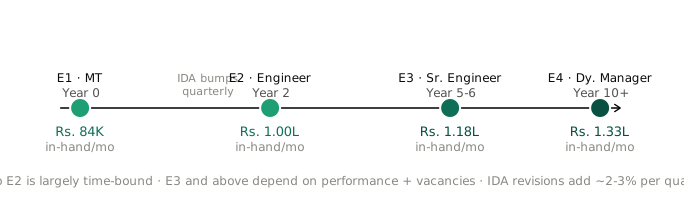
Promotions at HAL are largely time-bound for the first two grades -- most MTs reach E2 within 2 years. After that, performance reviews and vacancies start to matter more. IDA revisions, which happen four times a year, incrementally push up the gross without a formal promotion -- so your in-hand does grow even when you are not moving grades.
HAL vs ISRO vs BHEL: Which PSU Pays More In-Hand?
The pay scales across Schedule A PSUs are similar on paper, but the actual take-home varies based on HRA city, perks structure, and how each organisation applies the consolidated allowance.
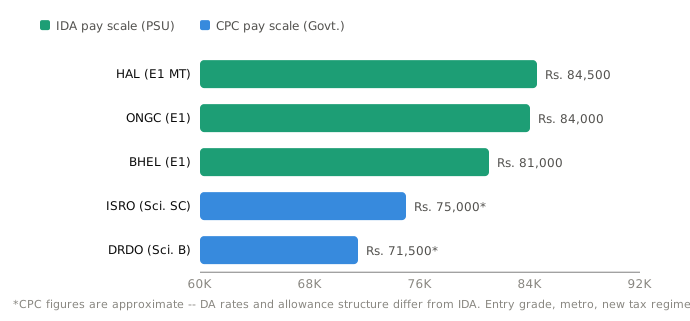
PSU | Entry Grade | Approx. Monthly In-Hand (metro) |
HAL (E1 MT) | Rs. 40,000 basic | Rs. 84,000 -- 85,000 |
ISRO (Scientist/Engineer SC) | Rs. 56,100 basic (7th CPC) | Rs. 70,000 -- 80,000* |
BHEL (E1) | Rs. 40,000 basic | Rs. 80,000 -- 82,000 |
ONGC (E1) | Rs. 40,000 basic | Rs. 82,000 -- 86,000 |
DRDO (Scientist B) | Rs. 56,100 basic (7th CPC) | Rs. 68,000 -- 75,000* |
*ISRO and DRDO follow CPC pay matrix, not IDA. Their DA percentage is different and their allowances are structured differently -- the comparison is approximate.
HAL holds up well. The IDA structure often results in a higher gross than CPC-based organisations at similar entry levels, because IDA has been running at 50%+ for the past few years.
New Tax Regime vs Old for HAL Employees
For most Management Trainees, the new tax regime is the better call. Here is why.
Under the new regime, the standard deduction of Rs. 75,000 reduces your taxable income. With annual gross around Rs. 9.5 -- 10 LPA and NPS employee contribution also deductible under Section 80CCD(1), a significant portion of your income is shielded. The 87A rebate takes care of the rest for most first-year MTs.
Under the old regime, you would need to claim HRA exemption, LTA, and Section 80C investments (NPS, PPF, ELSS) to beat the new regime. HAL employees who take the consolidated perks as taxable pay and do not have a home loan or large 80C portfolio are almost always better off staying in the new regime.
If your annual gross crosses Rs. 12 LPA -- which happens fairly quickly in E2 -- it is worth running both scenarios. The income tax calculator lets you compare new vs old regime side by side for your exact salary in under 30 seconds.
For the full HAL grade pay scales and IDA breakdown, see the HAL salary page. To reverse-calculate your CTC from a known in-hand figure, use the in-hand to CTC calculator.